
News & FAQ
News
Company news, technical insights and case studies from TAIFU.
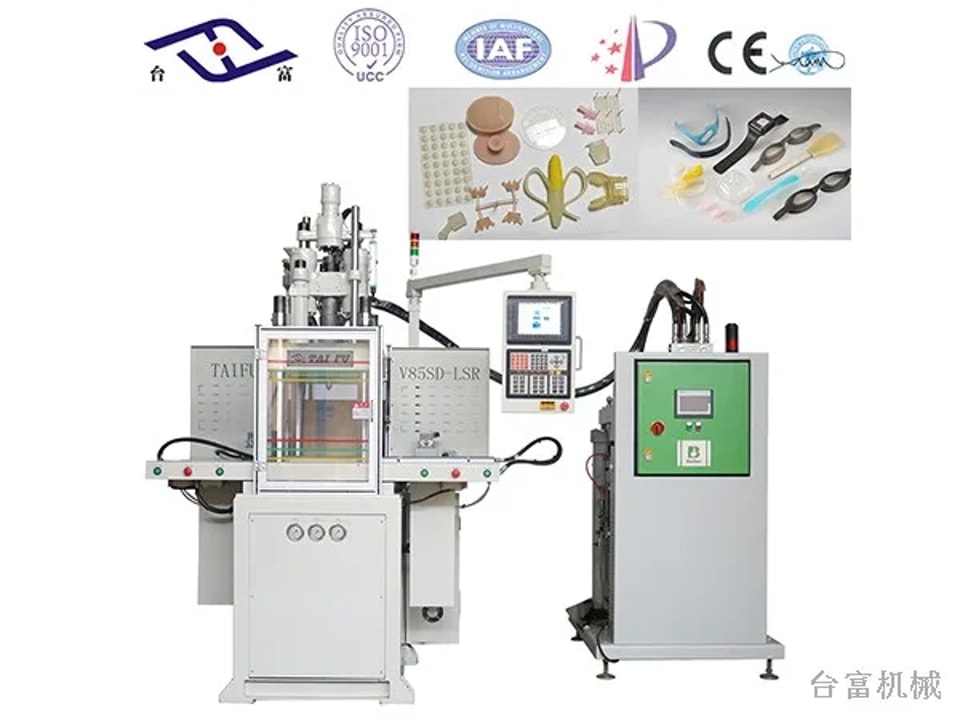
Apart from the way the mold is mounted, vertical and horizontal silicone machines work on the same principles. Vertical silicone machines make automation easy, and LSR offers several advantages: Excellent insulation, suitable for high-quality electronic plugs Insulating, mechanical and physical properties are maintained from 200 °C down to −40 °C Resistance to oxidation and aging, suitable for outdoor use Oil resistance Vertical LSR machines are available with single and double sliding tables for demanding LSR parts. Thanks to their clamping and sliding-table structure, vertical machines are better suited to manual demolding and insert parts. Horizontal LSR machines suit parts that can be ejected automatically, with short mold-open intervals and high efficiency in automatic demolding.
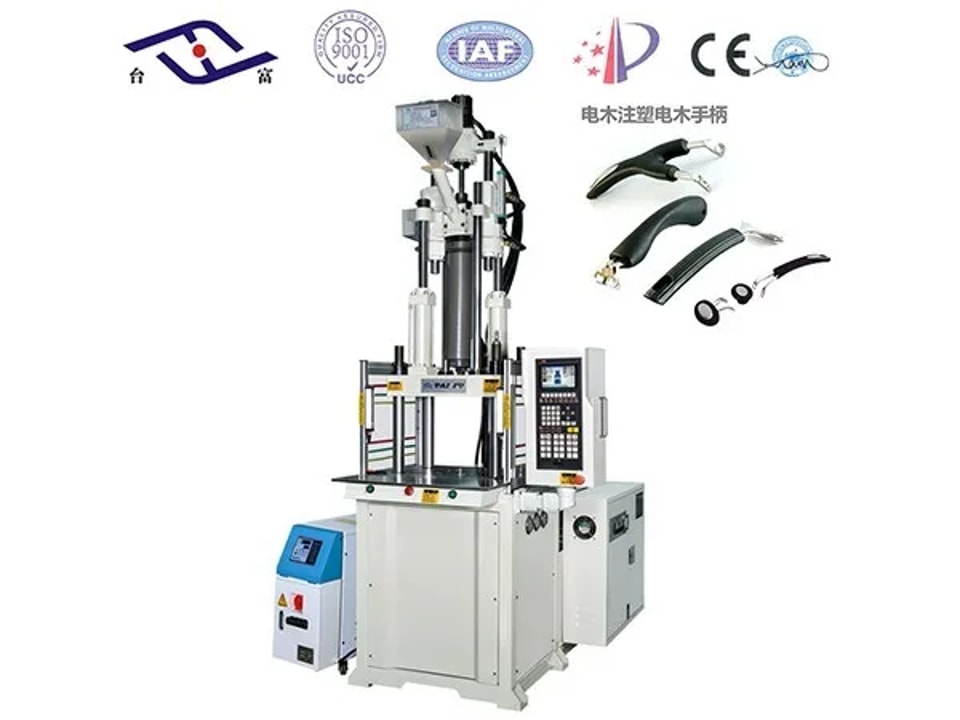
Taifu bakelite vertical machines produce a wide range of phenolic parts: tableware, handwheels, handles, knobs and grips, cookware and wok handles, pressure-cooker handles and lugs, switches, oven parts, terminals, meter parts and housings, and other functional parts used at high temperatures. Clamping forces range from 35 to 500 tons with shot weights from 60 g to 3,000 g. The molding principle is the same as for standard plastics, but because bakelite is a thermoset, the machine needs a dedicated barrel and screw assembly. The material is melted in the barrel, injected into the cavity and then cured by heat in a dedicated bakelite mold. Available series TFV4 — standard vertical machine, vertical clamping and vertical injection TFVS — single sliding table for easy insert loading and unloading TFVSD — double sliding table, for higher productivity and better protection of molds and operators TFVR — rotary table, from two stations (2R) to multi-station (5R), for single-operator or automated production
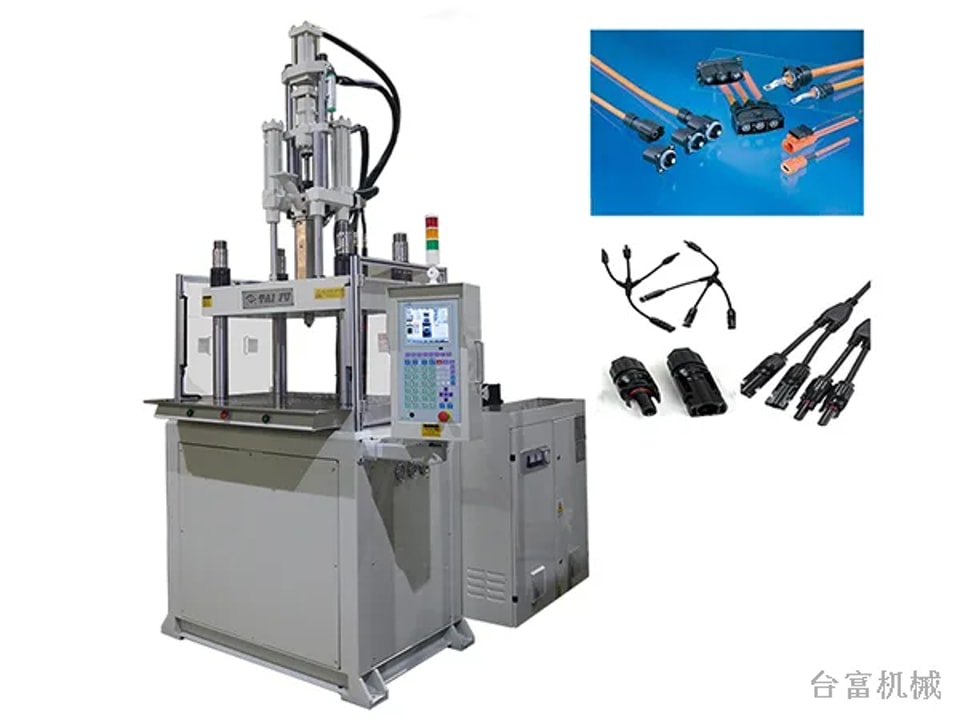
Taifu high-speed vertical machines are designed for ultra-thin-wall parts. They offer a large mold mounting area, injection speeds up to 500 mm/s and clamping forces from 35 to 500 tons, with vertical clamping and vertical injection. Versions Fixed table: fixed lower mold, moving upper mold. Sliding table: one upper and one lower mold; the lower mold slides in and out, so the operator's hands stay outside the clamping area. Rotary table: one upper mold and two or more lower molds, indexing 180°; can be fully automated to save labor. All three versions come with safety doors and light curtains, low-pressure mold protection and overload protection. Bosch Rexroth servo valves are optional, giving closed-loop injection control and high shot accuracy for thin-wall parts. Applications Connectors for new-energy vehicles and mobile phones, card trays, SIM and SD cards, contactless IC cards, fiber-optic connectors, reader-head holders, IC sockets and trays, small switches, waterproof plugs, eyewear nose pads, buttons, tags, overmolded shoe studs, and parts for clocks and cameras.
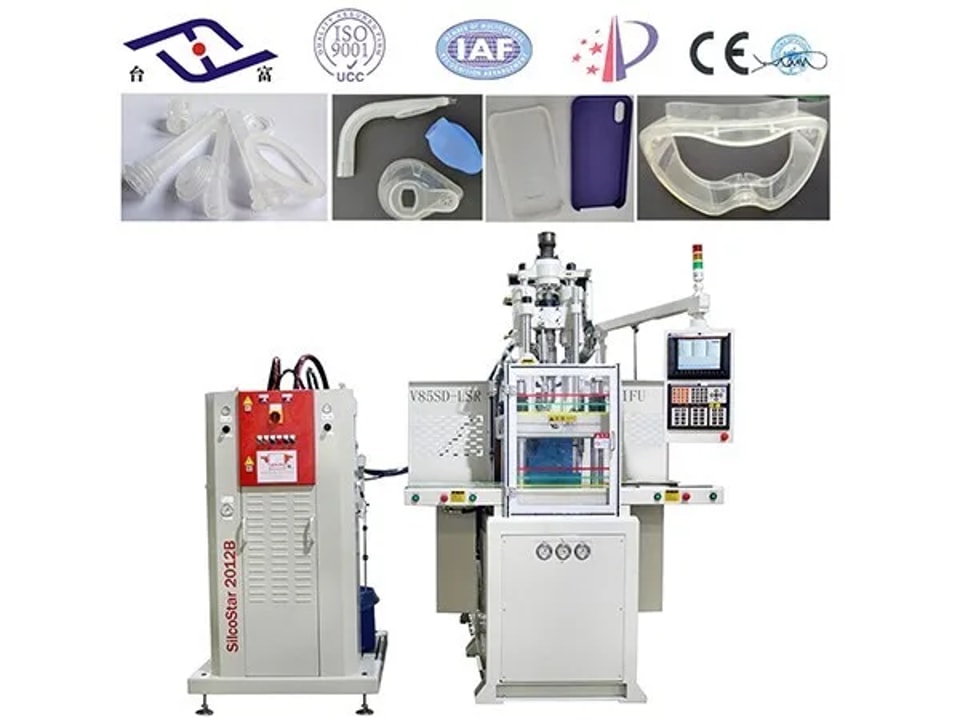
LSR injection machines produce silicone parts such as medical products (infusion tubes, breathing masks), baby products (nipples, teethers), food-storage lids and diving products. LSR shares the properties of conventional silicone rubber — heat resistance, electrical insulation and resistance to radiation and electrical discharge — and is available in general-purpose, high-strength, transparent and flame-retardant grades. The two liquid components, A and B, are loaded into the machine and mixed and molded fully automatically, simplifying the process and shortening cycle times. Hardness ranges from 10° to 70°. Typical products LSR keypads and baby bottle nipples — classic high-volume LSR parts. Although LSR costs more than solid silicone, high volumes and virtually no waste keep overall costs down, and LSR nipples are more transparent. Printer rollers and seals that require low compression set and good elasticity Products in direct contact with the body, such as masks, laryngeal masks and medical products Cable accessories, watch straps, phone cases, baby bottles, bowls, nose pads, earplugs, diving masks, tubing and automotive parts
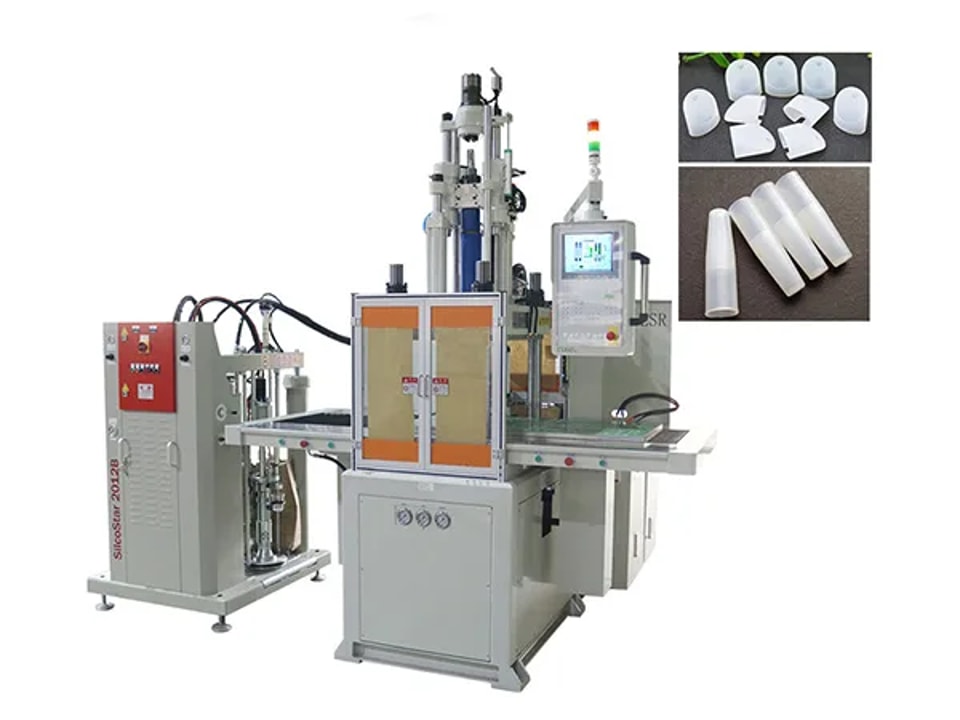
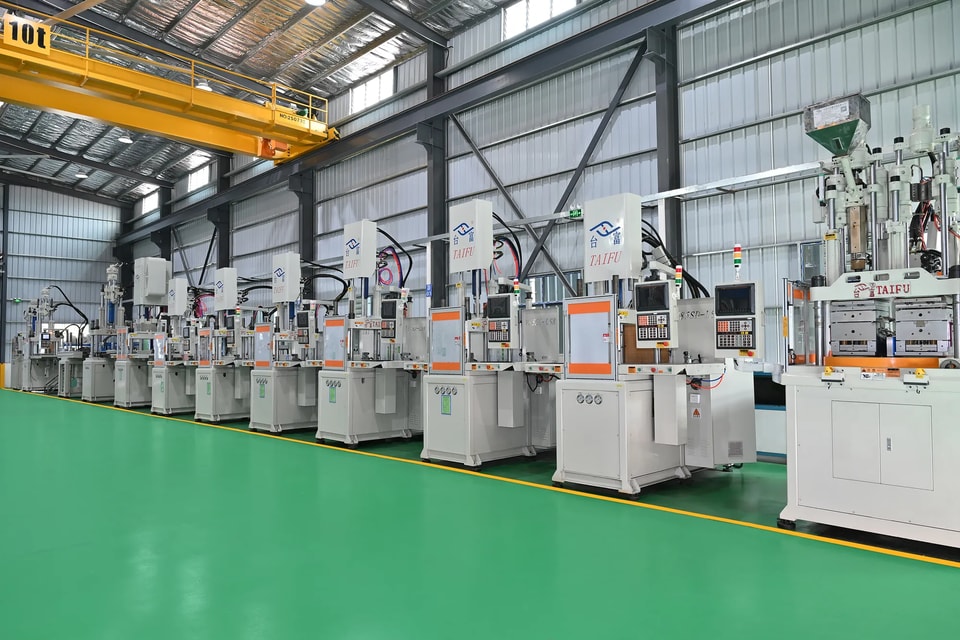
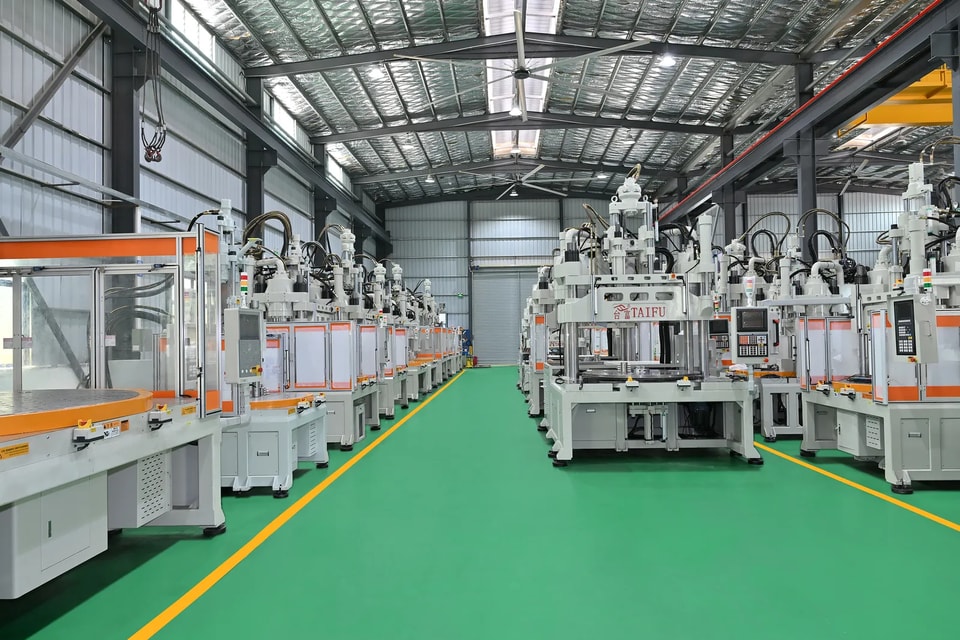
Dongguan Taifu Machinery traces its history back to 2009 and has over ten years of experience in building vertical injection molding machines. Taifu machines are sold across China and exported to Europe, South America, the Middle East and Southeast Asia. A network of international sales agents supports overseas customers, shortening delivery times and making after-sales service easier to reach. The company is organized into eight departments: administration, finance, sales, purchasing, production, engineering, planning and human resources. Taifu has also invested in information systems, including an office automation platform and an ERP system implemented with Digiwin (Yifei). Our guiding principles are people first, continuous improvement, innovation and mutual success, with the aim of creating more value and better service for customers.
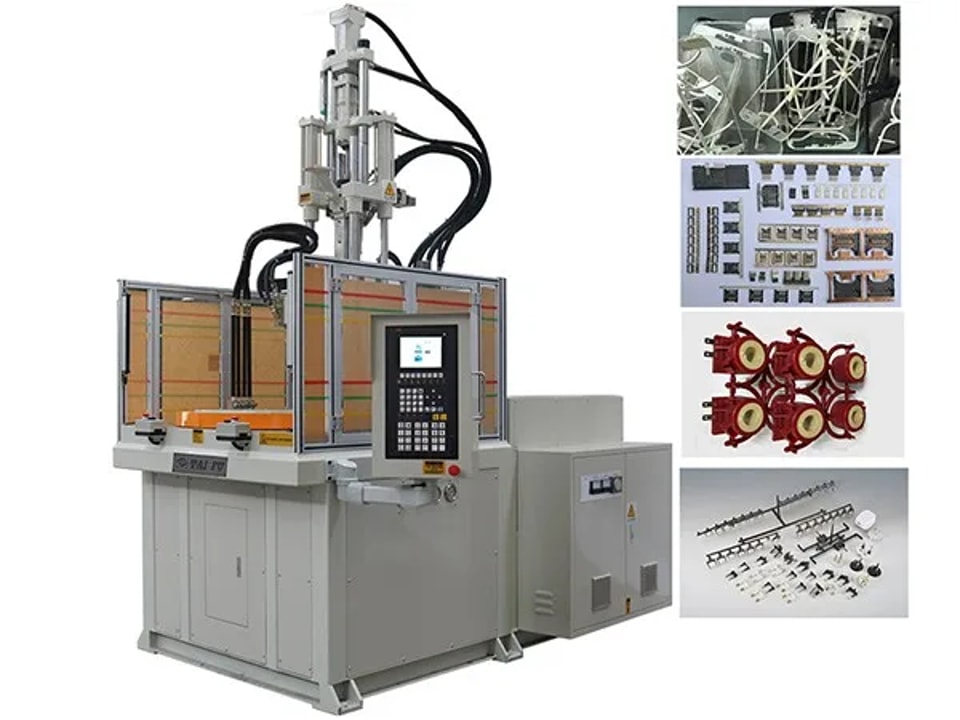
Proportional control The hydraulic system needs proportional pressure and flow valves, or a closed-loop variable pump system, to provide different working pressures and flows. Whether the pump is fixed- or variable-displacement, proportional valves control pump output pressure and flow with linear adjustment. Separate clamp and injection circuits On direct-pressure clamping machines, injection begins the instant high clamp pressure is built, while oil is still filling the clamp cylinder. If the two circuits were shared, the moving platen could be pushed back by fill pressure and mold-opening force, the pump could overload, and injection speed and stability would suffer. The clamp and injection circuits must therefore be separated. Fast response for high-speed molding High-speed vertical machines often mold at high injection pressure and speed — for connectors or keypads, for example — with fill times of only a few tenths of a second. The system must respond quickly; otherwise output lags the command signal, process setting becomes difficult and part dimensions and weight become unstable. Response depends on controller scan time, pump response and valve response. Systems with servo valves have a clear advantage in response and repeatability. On variable-pump machines, pressure and flow are adjusted by the pump swashplate angle, giving fast response and pump repeatability better than 0.2%. Mechanical, electrical, hydraulic and instrumentation integration Modern machines are fully computer-controlled, with operator dialog, fault self-diagnosis, process monitoring and SPC quality monitoring. The hydraulic system powers every movement, the controller manages it, and instruments monitor machine status — and a robot can be added for automated operation.
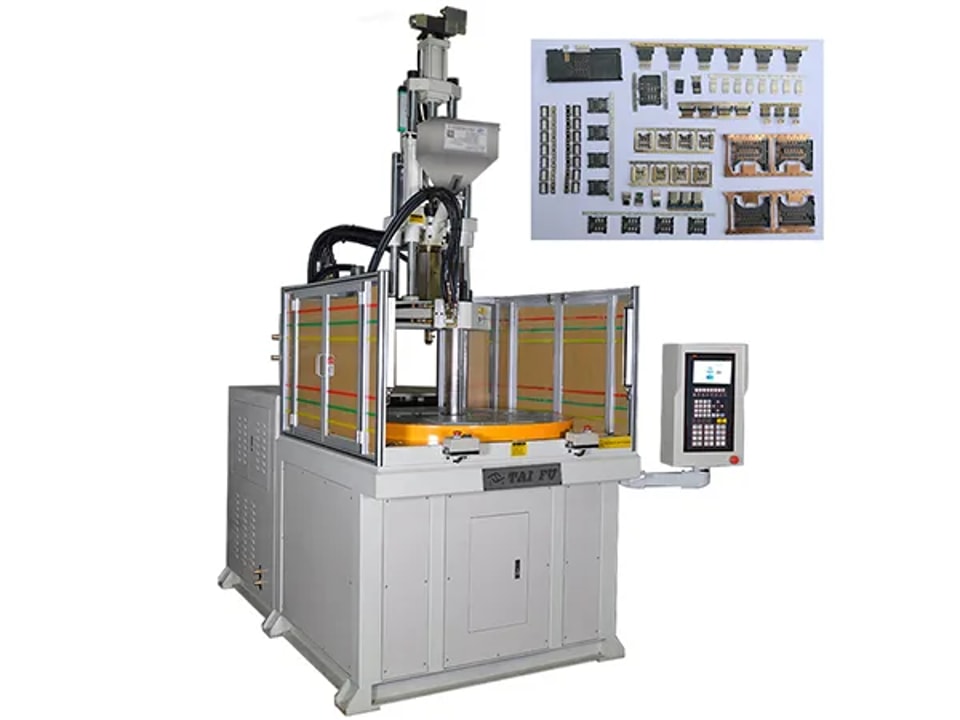
Thin-wall parts include connectors, waterproof plugs, eyewear nose pads, buttons, tags, overmolded shoe studs and small parts for clocks and cameras. How should you judge a high-speed vertical machine for this work? Repeatability Two measures are commonly used: repeatability of part dimensions and repeatability of part weight. Dimensions are hard to compare between parts of different size and thickness, so shot-weight repeatability is the better indicator of overall machine performance. A standard vertical machine typically repeats to around 1% by weight; a better machine reaches about 0.8%. Dimensional tolerances for such parts are often within 0.01–0.001 mm. Injection pressure Standard machines: 147–177 MPa High-speed precision machines: 216–243 MPa Ultra-high-pressure machines: above 243 MPa, typically 243–392 MPa Higher injection pressure brings three benefits: Better precision. Injection pressure has a marked effect on molding shrinkage; at around 392 MPa, shrinkage approaches zero and part accuracy depends mainly on the mold and environment. Tests show that raising injection pressure from 98 to 392 MPa can increase mechanical strength by 3–33%. Thinner walls and longer flow. With PC, a standard machine at 177 MPa can mold walls of about 0.8 mm, while 392 MPa allows walls down to about 0.45 mm and a higher flow-length ratio. Full use of injection rate. Rated injection rate is reached either by raising system pressure or by modifying the injection unit, including screw parameters. Injection speed High-speed vertical machines need high injection speed: above 200 mm/s for hydraulic machines and above 300 mm/s for all-electric machines.
Shot volume Shot volume is a key performance figure that indicates the weight of part the machine can produce. Depending on definition, it is expressed as theoretical shot volume, theoretical shot weight or actual shot weight. It is determined by screw diameter and stroke. Injection pressure The pressure the screw applies to the material during injection. It overcomes flow resistance from barrel to cavity, gives the melt the necessary speed and packs it. It is closely linked to part quality and dimensional accuracy, and is influenced by the plastic, the screw design and the processing temperature. Flow length and part weight increase with pressure, while shrinkage in the flow direction decreases. Injection rate To obtain parts with uniform density and stable dimensions, the cavity must be filled in a short time. Injection rate is the mass of melt injected from the nozzle per unit time. It is proportional to screw travel speed and inversely proportional to injection time, and can be calculated from screw diameter, injection speed, stroke and injection time. Injection power Power demand varies greatly across the cycle. The hydraulic system's peak power occurs during injection and is determined by injection speed and injection pressure. Plasticizing capacity and recovery Plasticizing capacity is the amount of plastic the injection unit can melt uniformly per unit time at maximum screw speed and zero back pressure. It depends on screw diameter, L/D ratio, screw speed and the material, and is governed mainly by the conveying capacity of the metering zone. Screw recovery time should be shorter than the part's cooling time; otherwise the cycle is extended.
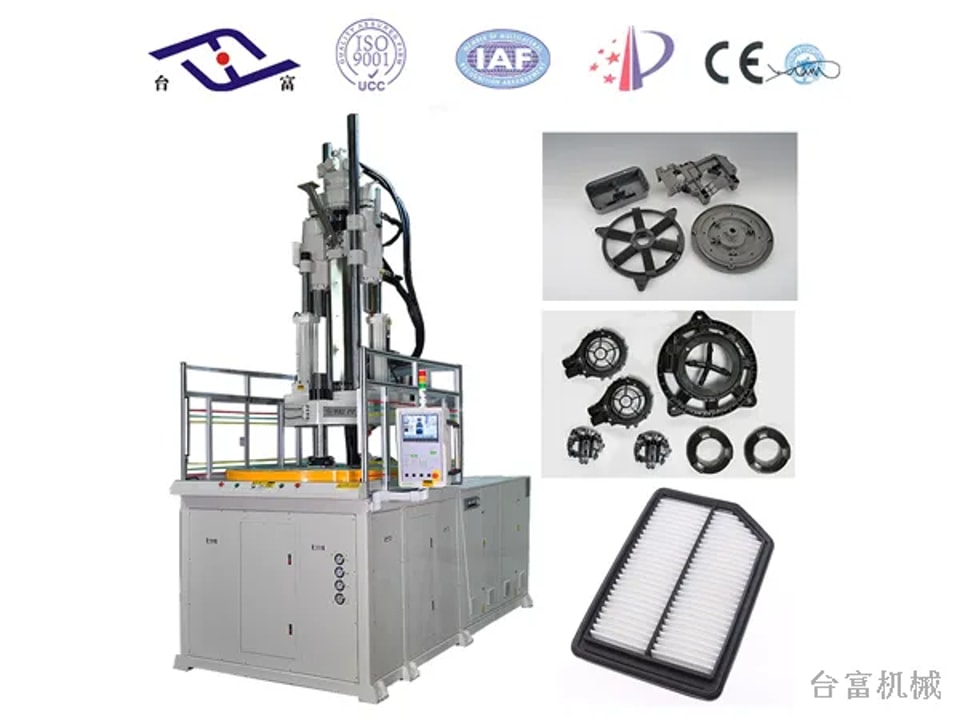
As vehicle lightweighting advances with electric and new-energy vehicles, overmolding on vertical machines is playing a bigger role in automotive manufacturing. Typical automotive overmolded parts Automotive glass encapsulation, filter screens, brake lever overmolding, seals, connectors and key overmolding can all be produced by two-shot or insert molding on sliding table or rotary vertical machines. Process requirements The process covers plasticizing, injection and molding. Good plasticizing is the precondition for part quality; injection must provide enough pressure and speed. Because average cavity pressure is typically 20–45 MPa, sufficient clamping force is essential — the injection and clamping units are the key components of the machine. Typical cycle on a vertical machine Load insert → screw forward → inject → hold → recover → decompress → cool → open mold → eject → retract ejector → remove part. Taifu machines for this sector include two-station rotary machines, cable-molding machines, LSR machines, high-speed machines, multi-color/multi-material machines, automatic strip-feed machines, energy-saving machines and rotary machines for new-energy battery cover plates.
Request a machine proposal
Enquiry about

© 2026 Dongguan Taifu Machinery Co., Ltd.